
LIFE’s Take on The European Commission’s Proposal to Amend the European Maritime, Fisheries and Aquaculture Fund (EMFAF) Regulation ((EU) 2021/1139)
On 21 September 2026, the European Commission published a targeted legislative proposal (COM (2026) 498 final) to amend Regulation (EU) 2021/1139 on the European Maritime, Fisheries and Aquaculture Fund (EMFAF). The Commission’s stated aims are to simplify administrative procedures, accelerate the energy transition, support generational renewal, and transpose the World Trade Organization (WTO) Agreement on Fisheries Subsidies.
While the Commission’s proposal introduces several improvements for Small-Scale Coastal Fisheries (SSCF), including a new Article dedicated to supporting viable and diversified SSCF activities (Article 30a) and some flexibilities —such as decoupling engine modernisation from power thresholds in SSCF— it falls short of addressing key structural demands raised by the Low Impact Fishers of Europe (LIFE).
Specifically, the proposal does not mandate a ring-fenced budget allocation for SSCF, lacks a bespoke pre-financing scheme and a simplified aid delivery mechanism, and does not restrict energy transition subsidies from benefiting destructive fishing practices.
Pillar A: Directed Support to Small-scale Coastal Fisheries?
A major addition in the proposal is the introduction of Article 30a, creating a dedicated funding scheme under Priority 3 specifically aimed at sustaining viable small-scale coastal fishing and supporting income diversification.
This is certainly a positive step forward. However it falls short of meeting the demands of the Low Impact Fishers of Europe (LIFE), the LIFE Youth Network (Youth Summit Declaration 2026), and the Energy Transition Partnership SSF Working Group. Article 30a and the broader package fall short in three key areas:
- No Mandatory Budget Ring-Fencing: Article 30a identifies SSCF as an eligible activity, but fails to make budget ring-fencing mandatory, and does not set aside a minimum percentage of national EMFAF allocations exclusively for SSCF.
- No Bespoke SSCF Aid Delivery System: The provision to allow Member States to simplify national application processes and to maintain a 100% aid intensity rate for SSCF is welcome, but does not ensure any improved access for this sector. It relies on the discretion of Member States to prioritise SSCF funding without providing any mechanisms to assist this, such as upfront pre-financing, micro-grants, technical support or simplified 1-page application forms to overcome administrative burdens.
- Focus on Diversification over Core Sectoral Viability: It promotes diversification through complementary income generation rather than focussing on the viability of fishing activities, direct marketing and product differentiation, or, more crucially, support for SSCF associations to establish dedicated SSF Producer Organisations (POs). Producer Organisations are key for the implementation of the CFP and for channeling sector support to the fishing sector. It’s therefore important for SSCF associations to have their own dedicated SSCF POs with dedicated lines of funding.
Pillar B: Decarbonisation & Energy Transition
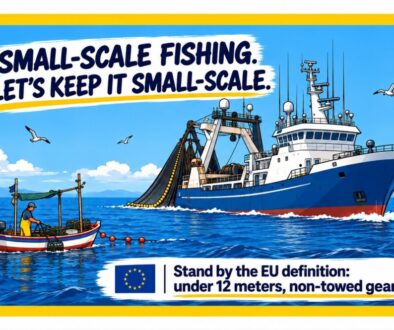
Providing definitions for “energy transition”, “pilot projects”, and “demonstrators” (Art. 2) is helpful, as is maintaining the definition of SSCF. The STECF AER for 2024 highlights the relevance of this definition for establishing the socio-economic contours of the sector. The introduction through Article 19a of targeted funding for energy infrastructure in ports, quays and docking areas and pilot testing of alternative fuels is also a welcome development. It is also positive to note that it introduces a differentiated approach for modernisation of engines for vessels under 12 metres using non-towed gear and no longer requires keeping engine power strictly unchanged, provided it yields measurable reductions in CO2 emissions.
However, amendments proposed under Articles 18 and 19 keep the door open for subsidised replacement of old engines with new ones in vessels up to 24 meters using high impact gears (e.g. towed gear / bottom trawlers). Although this support is conditional on maintaining power thresholds, energy transition and engine replacement rules under Article 18 and 19 should explicitly prioritize low-impact, passive-gear operators and prevent public funding from expanding destructive fishing or otherwise increasing the risk of overfishing.
Moreover, raising the general spending ceiling on fleet measures from 15% to 30% of EMFAF under Articles 17,18, 19 and 20 without setting aside a guaranteed minimum percentage for small-scale fisheries risks recreating past imbalances. Member States may direct the increased fleet budget toward larger, capital-intensive vessels unless national programming explicitly prioritises SSCF.
Pillar C: Generational Renewal & Business Transfers
To combat the severe demographic imbalance , the Commission’s new proposal facilitates business transfers to young entrants and small-scale fishers (Art. 13.1g) and increases EMFAF aid intensity for vessel acquisition by young fishers from 40% to 60% (Annex III, row 1).
This is welcomed by LIFE, but capital barriers remain one of the biggest obstacles for young fishers (men and women) entering the sector. LIFE therefore calls for 100% financing for such grants, with pre-financing facilities for young entrants. Moreover, Article 17 should be amended so as to restrict the first acquisition of fishing vessels to vessels below 12m in overall length and using non-towed gear.
Pillar D: Governance, Co-Management, and Biodiversity
LIFE fully agrees with strengthening environmental safeguards and transposing the WTO Agreement on Fisheries Subsidies into EU law. This includes Article 3 on subsidies contributing to illegal, unreported and unregulated fishing, making operators involved in IUU fishing or unregulated high-seas fishing strictly ineligible for support, and Article 4 on subsidies regarding overfished stocks. Given that ICES and EEA estimate that 40 to 60% of EU stocks are overfished, this must be taken into account when granting support for fleet renewal, especially for the larger vessel fleet.
However, LIFE wonders if there is much to celebrate, i.e. if the transposition is worth the paper it is written on. Core prohibitions, notably on subsidizing overcapacity, are significantly constrained or negated in practice by major legal exclusions, missing disciplines, and structural loopholes.
In effect, the WTO fisheries subsidies agreement (Fish 1) seems to provide a stick with one hand to beat down subsided overfishing but breaks it with the other.
What is more, it seems that in the revised EMFAF regulation, it is only Article 5.1. that has been transposed, leaving out Article 3. and 4 on subsidising IUU activities and overfishing. THis needs to be clarified.
On a more positive note, LIFE especially welcomes the new additions on Article 25(h) allowing support for national strategies for Marine Protected Areas (MPAs), fisheries-restricted areas, and the development of fisheries co-management schemes.