
Catch of the Day – November 2025
Vijesti o poštenom ribarstvu, zdravim morima i živahnim ribarskim zajednicama
LIFE Elects its New Board of Directors
LIFE is pleased to announce the election of its new Board of Directors, bringing together a diverse group of representatives from across Europe’s main sea basins. This renewed leadership reflects LIFE’s commitment to ensuring that the voices and perspectives of small-scale fishers are heard from the Baltic and North Sea to the Mediterranean and Black Sea. The newly elected Board will guide LIFE’s strategic direction and strengthen its role in advocating for sustainable and fair fisheries.
New BOD composition:
Mediterranean and Black Sea Region:
Federico Gelmi, Associazione Pescatori di Pantelleria (Italy)
Kazimir Bogović, Udruga malih priobalnih ribara Jadrana (Croatia)
Macarena Molina, Pescartes (Spain)
Baltic and North Sea Region:
Bengt Larsson, SYEF (Sweden)
Kasia Stepanowska, Darłowska Group of Fish Producers and Shipowners (Poland)
Erik Meyer, Fischereischutzverband Schleswig-Holstein (Germany)
Atlantic Region:
Gwen Pennarun, Brittany Handliners Association (France)
Sharing seats North Atlantic: Seamus Bonner, IIMRO (Ireland) / Bally Philp, SCFF (UK)
South Atlantic: Sandra Amezaga, Mulleres Salgadas (Spain) / David Pavon, Cofradia el Hierro (Spain)
With a refreshed Board, LIFE looks forward to continuing its mission to empower small-scale fishers and champion sustainable, low-impact fisheries across Europe.
24/11 LIFE Calls for an EU Plan of Action for Small-Scale Fisheries at Implementation Dialogue with Commissioner Kadis
LIFE took part in the Implementation Dialogue on Small-Scale and Coastal Fisheries, the second in a series of such stakeholder dialogues, organised by the European Commission and hosted by Commissioner for Fisheries and Oceans Costas Kadis. Representing LIFE, Marta Cavallé, Executive Secretary, delivered a strong message on behalf of Europe’s small-scale, low-impact fishers, calling for urgent and concrete action to secure their future.
In her intervention, Marta stressed that despite decades of political recognition of small-scale fisheries (SSF), this has yet to translate into meaningful improvements. She highlighted the outcomes of the recent Učinite ribolov poštenim Forum, where 43 fishers from 16 countries warned that Europe has reached a tipping point of decline and cannot afford further delay in restoring fish stocks, safeguarding coastal livelihoods and ensuring fair access to resources.
LIFE urged the EU to adopt a Plan of Action for Small-Scale Fisheries in Europe by 2026, rooted in the FAO SSF Guidelines and based on a differentiated approach between small-scale and larger-scale fisheries. LIFE also submitted detailed written responses to Commission’s questions outlining barriers for generational renewal, barriers faced by SSF in accessing EU funding, the need for ring-fenced budgets, tailored capacity-building, recognition of SSF Producer Organisations, and concrete measures to ensure that administrative and regulatory systems are truly fit for purpose. Additional recommendations addressed data gaps, fisher-led technologies, co-management, climate adaptation, and the training needs required for a modern, resilient SSF workforce.
LIFE welcomed the Commissioner’s commitment to continuing this dialogue, but emphasised that, within the Common Fisheries Policy (CFP), Europe already has the tools to act. By adopting a Plan of Action with a binding timeline and embedding it in the upcoming Ocean Act, the EU can ensure that the SSF can play its part in restoring its seas, promoting responsible fisheries, and ensuring that coastal communities thrive.
As Marta concluded: “It is time to recognise small-scale fishers not as the past, but as part of the future of sustainable European fisheries. Together, we can make fishing fair"..."
17/11 LIFE Unites Small-Scale Fishers in Brussels for the Make Fishing Fair Forum

LIFE, in tight cooperation with Blue Ventures, brought together 43 small-scale fishers from 16 European countries in Brussels as part of the Make Fishing Fair Forum.
Fishers in the room reiterated what LIFE has long warned: after years of policies favouring industrial fleets, Europe’s inshore fish stocks are collapsing and small-scale fishers are being pushed to the brink. The fishers at the Forum made a unified call for an EU Plan of Action for Small-Scale Fishing by 2026, aligned with the FAO SSF Guidelines, to rebuild stocks, secure access in coastal waters, ensure fair allocation, strengthen co-management and support new entrants. LIFE asserts that the Plan, part of a wider Make Fishing Fair Roadmap, should be included in the Ocean Act with a binding timeline for Institutions and Member States.
Commissioner Kadis, who addressed fishers and stakeholders in the afternoon session of the event. He asserted that “our small-scale fisheries are vital to the heart of our coastal communities”, acknowledged the urgency, noting the crises in the Baltic and Mediterranean and the importance of upcoming EU processes, including the 2026 Ocean Act. A number of LIFE members took the floor, including: Gwen Pennarun (LIFE), Muireann Kavanagh (IIMRO), Evelina Doseva (European Association European Association of fishermen at the black sea), Patricia Bros (Asociación de atuneros con linea de mano del mediterráneo), Søren Jacobsen (FSK-PO), Noora Huusari (Snowchange), Ken Kawahara (Association des Ligneurs de la pointe de Bretagne). Fishers on the panel and in the audience shared practical examples of best practices and low-impact solutions, while highlighting persistent political and legal barriers that hinder progress. A stakeholders’ panel presented diverse perspectives on advancing justice in EU fisheries policy, with contributions from Charles Braine (Pleine Mer and Poiscaille), Bellinda Bartolucci (ClientEarth), and MEP Luke Ming Flanagan (The Left), who highlighted the need for the EU to protect small-scale fisheries jobs and way of life. MEP Gabriel Mato (EPP) also intervened to underscore the importance of the small-scale fisheries sector.
For LIFE, the MFF Forum confirmed the strong unity among Europe’s small-scale fishers. Their shared experience and determination form a powerful foundation for pushing the EU toward genuinely fair, sustainable and inclusive fisheries.
14/11 Commission Publishes Vademecum on Article 17
The long awaited Vademecum contains guidelines that seek to help EU countries in supporting small-scale fishers and enhancing transparency and good governance in the allocation of fishing opportunities by EU countries. According to Commissioner Kadis “These guidelines invite EU countries to reflect on the allocation of fishing opportunities, bearing in mind that small-scale fishers are the most vulnerable to structural and unexpected challenges. Small-scale fishers are the backbone of our coastal communities. We must recognise their role and provide them with the necessary support".
4-5/11 Energy Transition in Fisheries – From Visions to Actions
The Conference on Energy Transition in Fisheries – From Visions to Actions took place in Helsinki, bringing together Northern European stakeholders to discuss practical steps toward decarbonising the fisheries sector. LIFE was represented by Christian Tsangarides, Baltic and North Sea Coordinator, who contributed to the panel discussion “Can Decarbonization in Fisheries Be Achieved by 2050?”, where the discussion explored what can already be done to reduce emissions, the medium-term technologies that could be adopted without compromising the economic viability of fishing vessels, the long-term outlook for developing and deploying carbon-free fuels, and the need for tailored approaches that reflect the different realities of small and larger vessels. With a focus on the Northern European fisheries sector, pitches from entrepreneurs for solutions to the energy transition were presented with the winning entry being for solar powered electric boats.
5-6/11 Round Goby Project: Meeting & Study Visit in Lithuania
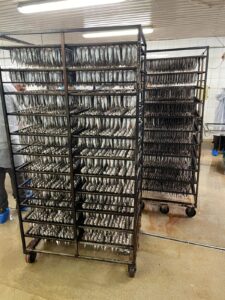
On 5–6 November, LIFE took part in a two-day meeting of the Round Goby project and study visit in Lithuania, organised jointly by project partners Submariner, KTU Food Institute, MCS and SLU. The visit provided valuable insight into Lithuania’s coastal fisheries, processing sector and the ongoing pilot activities within the Interreg Round Goby project.
The first day began with a study visit to Baltijos Konservai, a canning factory processing a variety of Baltic species. Participants had the opportunity to observe the production process and taste prototypes of canned round goby developed within the project.
This was followed by a field visit to meet local small-scale coastal fishers operating in the Klaipėda region. Lithuania’s coastal fishery is organised into 29 commercial fishing areas where operations are carried out by approximately 50–60 active fishers, each holding transferable fishing rights tied to specific gears. The main species caught with fyke nets and gillnets include smelt, Baltic herring, round goby, plaice and sprat, with total coastal landings amounting to around 300–600 tonnes annually.
Round goby fishing is concentrated in northern coastal zones close to the Latvian border. Despite being a profitable segment—with average margins around 38%—the fishery has declined by 72% (from 228 tonnes in 2016 to about 64 tonnes in 2023), likely due to reduced opportunities for cod and herring. Today, about 18 fishers target round goby, and five companies account for roughly 90% of landings. Much of the catch is exported to Latvia for processing and then further distributed to the Black Sea region.
18/11 S&D event: the Future of the Common Fisheries Policy
LIFE staff and members from Spain, Denmark and Norway took part in a high-level event organised by the Socialists and Democrats Group in the European Parliament, dedicated to the scientific, environmental, social and economic dimensions of fisheries policy. Christian Tsangarides, LIFE’s Baltic and North Sea Coordinator, contributed to Panel 1: “The science of fishing and fishing with science,” alongside experts from the Spanish Institute of Oceanography and the Azores Fisheries Observer Programme. When tackling the issue of stock status, Christian emphasised: “we want a full commitment to putting more fish back in the sea — this must be the foundation of our policy. The current scientific ‘recipe’ is not one for Europe, not one for small-scale fishers, and certainly not one for the future.” LIFE welcomed the opportunity to bring the perspectives of small-scale, low-impact fishers into these key political discussions.
Press review:
Make Fishing Fair event: Fish Focus, The Skipper, Commissioner’s speech, Fisker Forum, ilgiornaledeimarinai, The Fishing Daily, Through The Gaps! Newlyn News, Mundus Maris, La Nazione
LIFE Members from France meet with new national Fisheries Minister, Catherine Chabaud
Publication of the 2025 Annual Economic Report on the EU Fishing Fleet (STECF 25-03 & 25-07)
The EU Pushes for Transparency and Sustainability in Fisheries Quota Allocation
The Pointe Bretagne Hand Liners call for support to combat the use of high open bottom trawls (“4 door trawls”) in the coastal zone, within the 3 to 9 mile zone (in French):
EU secures 17% increase of bluefin tuna fishing quota at ICCAT annual meeting
FAO publishes interactive map on the state of world marine fishery resources
Coming up:
10/12, online: LIFE’s Board of Directors meeting and General Assembly
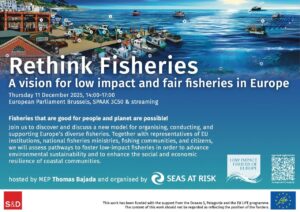
11/12 in the European Parliament, Brussels: LIFE and Sea at Risk are organising the event “Rethink Fisheries – A vision for low impact and fair fisheries in Europe”.
After two years of collaborative work involving fishers, civil society, scientists, and actors across the seafood value chain, we are excited to present a shared Vision for a just transition toward low-impact and fair fisheries in Europe. Join us and register here.


 LIFE actively participated in this year’s
  22/10 LIFE members excluded from market as they lack MSC certification


 On 3 September, LIFE took part in the
  On 9 September, LIFE Senior Advisor Jeremy Percy attended the



 Croatian
  English
  Dutch
Dutch  French
  German
  Greek
Greek  Italian
  Polish
  Romanian
  Spanish
  Maltese